

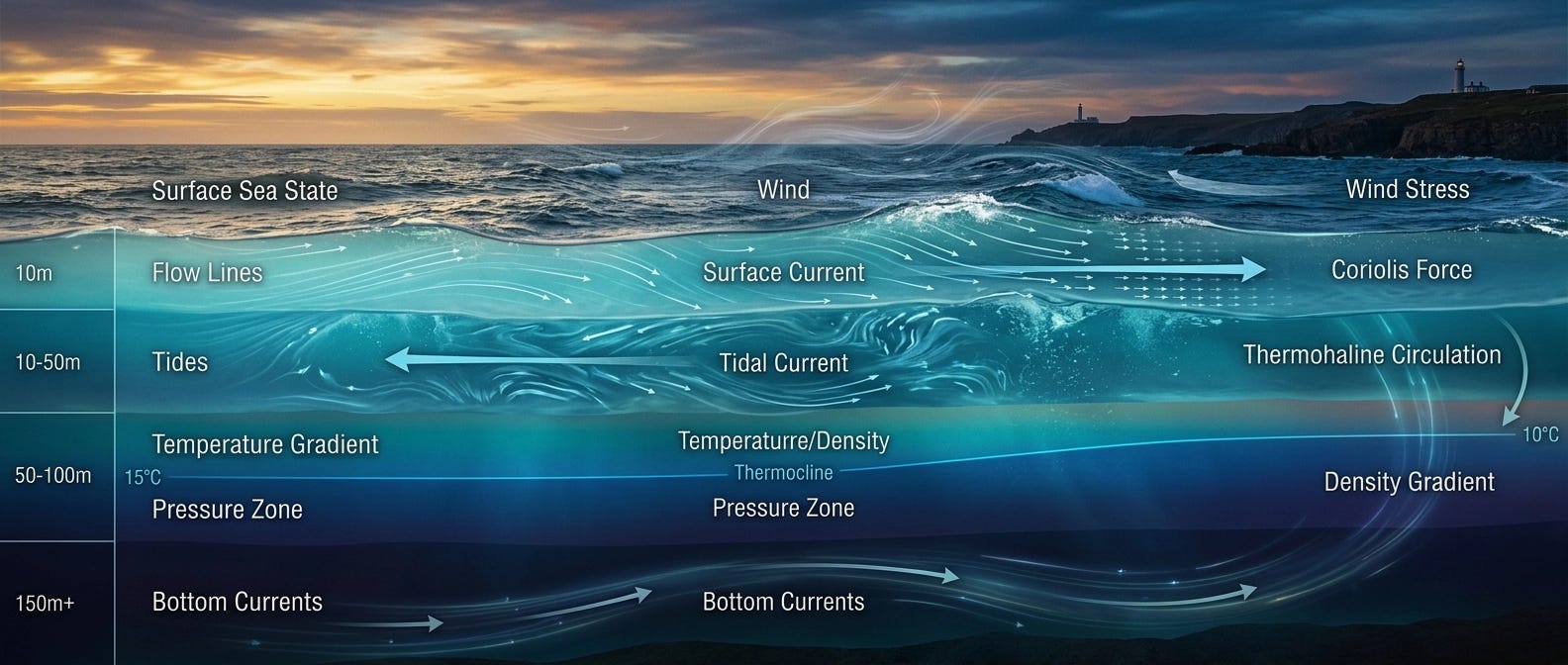
In #07 Before You Set Sail, we introduced the Sea State Index.
The goal was to create a way to understand the environment surrounding a business without falling into another dashboard metric. The Index provided a single score that summarized the forces shaping the market.
One number can quickly show whether the forces surrounding a company are helping or hurting its progress. That number provides value and direction. It also compresses signals needed to understand the company’s place inside the current market.
Two companies can share the same market, face the same competitors, and operate under the same economic conditions. One advances while the other struggles. The composite score alone cannot explain why. To answer that question, we need to go deeper.

A Sea State score tells us what the environment looks like. It does not show how a company is handling that environment.
The expanded model considers three reference points.
The market average establishes an overall condition.
The peer median shows how comparable competitors are performing inside those conditions.
The target company score shows where a specific organization sits relative to both.
This converts a straightforward weather report into a position report.

Website metadata targeting (aka “Target”)
In this example, the market is relatively neutral. Most peers perform slightly better than the market. The target company performs substantially better.
The natural question is: What is this company doing differently?
That answer sits inside the individual forces.
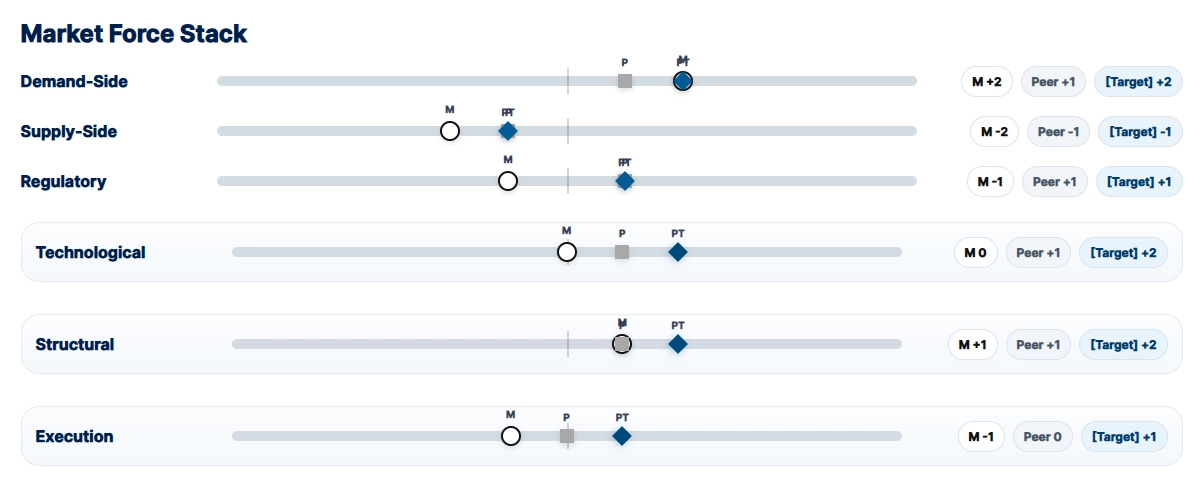
Demand — customer pull and market appetite
Supply — competitive pressure and alternatives
Regulation — rules, compliance, and oversight
Technology — innovation and adoption shifts
Structure — market architecture and barriers
Execution — ability to capture opportunity
Reading the Currents
Separating the forces reveals where a company is creating advantage and where additional opportunities for growth may exist.
In this example, technology and execution emerge as clear strengths. The company captures both more effectively than the broader market and its peer group, helping explain its position above both.
Structural forces point toward the next layer of opportunity. While the company performs well, it remains closely aligned with peer performance. That may indicate room to translate operational strengths into deeper market advantages through ecosystem development, workflow adoption, integrations, or other forms of entrenchment.
Supply remains negative across the market. Buyers still have multiple credible alternatives for solving the same problem. Increasing sales activity and tactics may generate incremental gains, but meaningful growth often comes from reframing the problem in a way that makes the company’s value easier for buyers to recognize. New problem definitions frequently create new paths to revenue.
The force stack shows where a company is outperforming, where it is keeping pace, and where the next opportunity for advantage may be hiding.
The Sea State Index provides a fast way to understand external conditions. Expanding the model reveals why organizations operating in the same market often achieve very different outcomes and where the next opportunity may be found.