


Understand The Market You Are In
Every company operates inside forces it does not control.
Some markets help. Some hinder. Most sit somewhere in between.
The Sea-State Index measures those conditions on a scale from −5 to +5. Negative readings indicate headwinds. Positive readings indicate tailwinds. Most companies fall somewhere between −3 and +3.
A score near zero is not normal. A score below −2.5 is unusual. A score above +1.5 often means the market itself is helping create momentum.
The index is built from six external forces:
Demand
Supply
Regulation
Technology
Structure
Execution
Together, they describe the environment surrounding a company.
The examples below show four very different conditions. Three companies. Four readings. Four lessons about the water they are sailing through.
Reading One: +1.9 | Open Water
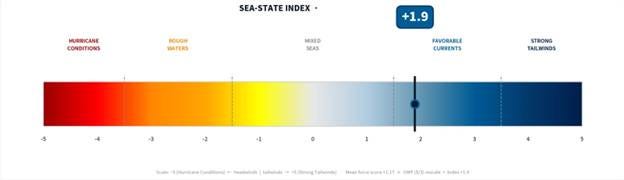
A retail intelligence platform operating in the loss prevention market
Demand is strong, and the market broadly supports the company's motion. Two forces push back, but neither is powerful enough to overwhelm the structural tailwinds working in its favor.
The result is a reading of +1.9.
This does not mean success is guaranteed. It means the company is operating with the current rather than against it. Growth becomes more dependent on execution than survival.
When the market is helping, strategy becomes an allocation problem. The question is no longer whether growth is possible. The question becomes where to place resources to capture the most value.
Reading Two: −2.85 | Hostile Conditions
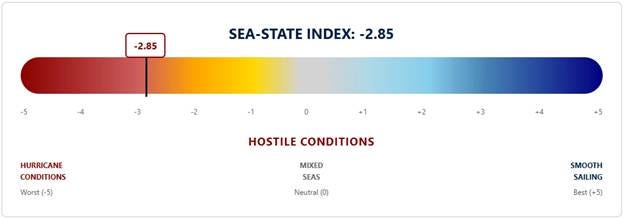
An AI infrastructure company operating in the data center build-out market
Five of the six forces push against the company. Only one provides meaningful support.
At first glance, that feels counterintuitive. The market itself is expanding rapidly. Capital is flowing. Demand for AI infrastructure continues to grow.
Instead of demand, the problem is leverage.
A small number of buyers control a disproportionate amount of revenue. Those buyers can delay projects, redirect spending, or wait for the next technology cycle while the company remains committed to long-term capital investments.
The market is expanding, but the balance of power is not changing.
A small number of buyers still control the outcome.
The mistake is assuming a growing market is a favorable market. The Sea-State Index separates those two conditions. A category can expand while simultaneously becoming more difficult to navigate.
This reading is not a judgment on the company. It is a condition report on the environment.
The leverage exists long before the pipeline reveals it.
Reading Three: 0.0 | The Contested Middle
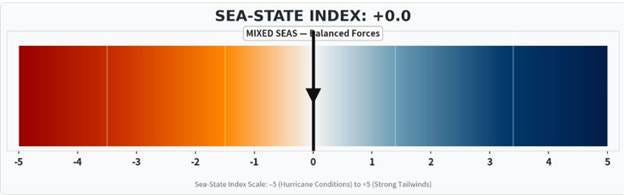
A service and installation firm operating inside a PE-backed roll-up
Two forces push forward. Two push back. Two remain largely neutral.
The result is a reading of zero.
The “zero” does not mean “stagnant”.
Demand continues to grow. Technology supports the market’s direction. But changes in competitive structure are pulling with equal force in the opposite direction. National procurement models are shifting decisions away from local operators, changing how value is captured and who controls the buying process.
The forces balance, but that creates a dangerous illusion.
Leaders may interpret a neutral environment as a sign of stability. In reality, a neutral market often represents a contested market. Markets in this situation are just one move away from significant change. because the environment has not yet committed to a direction.
The Sea-State Index is signaling that outcomes will be determined by how the company responds to the next shift in conditions.
Reading Four: +0.5 (PLG) → −0.2 (Enterprise) | The Motion Shift
A visual collaboration platform running two separate go-to-market paths
Same company.
Same product.
Same use cases.
Two very different readings.
Product-Led Growth Motion
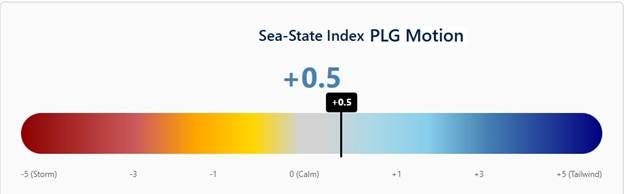
In the PLG motion, demand is healthy, adoption is relatively frictionless, and timing works in the company’s favor. The positive forces slightly outweigh the negative ones.
The reading lands at +0.5.
Enterprise Motion
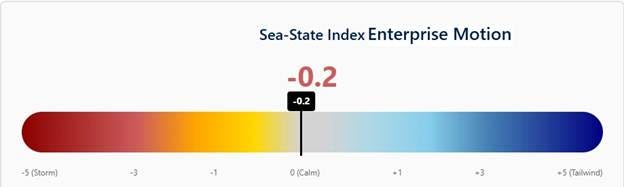
In the enterprise motion, demand actually increases. Technology signals become stronger as well.
Here, the reading falls.
Procurement scrutiny appears. Compliance requirements emerge. Buying committees expand. Budget cycles lengthen. More stakeholders gain veto power over the decision.
The same company can operate in multiple Sea-States simultaneously because each route to market exposes a different set of forces.
Two motions.
Two environments.
Two strategic realities.
What the Index Is Actually Measuring
The Sea-State Index does not measure company performance.
It measures the conditions surrounding performance.
That distinction is important.
Revenue can rise inside a hostile market. Revenue can stall inside a favorable one.
The index reveals whether the environment is helping, hindering, or remaining indifferent to the strategy being executed.
Think of it as orientation rather than evaluation.
It tells leaders what kind of water they are in before they commit resources, revise forecasts, or explain results to a board.
The examples above span conditions from −2.85 to +1.9.
No company reaches +5.
No company reaches −5.
Those numbers represent theoretical extremes. Real companies live in the middle, pulled by forces they did not choose and often cannot control.
The Sea-State Index provides a way to see those forces before they become outcomes.
Understanding the currents/forces is not strategy.
But it is where strategy begins.
The next question is different.
If the Sea-State tells you where the winds are pushing, how do you identify the specific dangers that could sink the journey?
That is where we go next.