


Most teams prioritize resources based on personal agendas, internal echo chambers, or the preferences of their biggest customer.
The result is predictable: effort gets too thick in some places and too thin in others.
In the previous edition, you were introduced to the Course Correction Canvas: a quick way to see where the business stands, where the market expects it to be, and which gaps matter most.
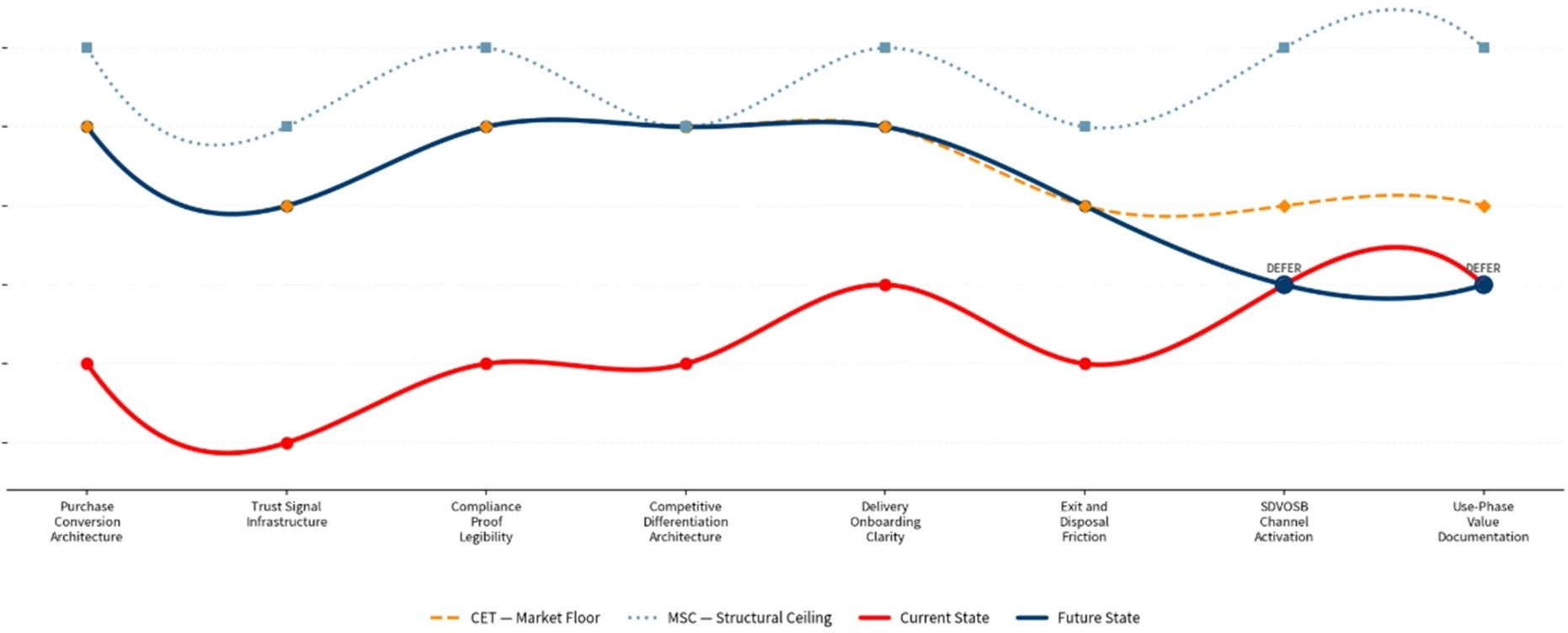
(From: The Course Correction Canvas posted April 19, 2026)
But the chart is only the starting point.
Real change comes from understanding what sits underneath those gaps and what kind of work each lever requires.
A leadership team can see the gap and still choose the wrong focus.
“Improve,” “defocus,” and “adjust” suggest direction.
They do not show magnitude.
Which lever matters most?
What should be protected?
What should be created, reduced, or abandoned?
The table underneath the Canvas gives leaders a cleaner action language:
Remove what creates drag
Shrink what absorbs effort without enough return
Elevate what already works but needs more force
Innovate where something missing has to be built
Maintain or defer what does not need attention now
The Canvas points to the movement needed.
The table puts a target on the effort required.
Example #1: When the missing structure must be created
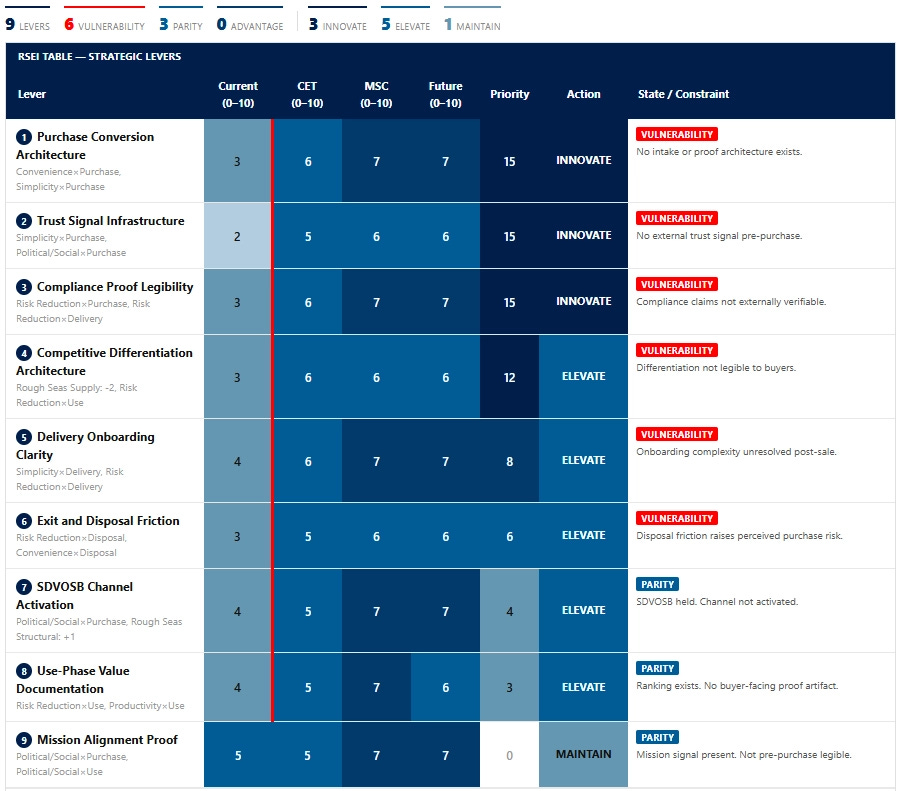
This MSSP shows a common pattern: the Evaluation Entry Gap.
Prospects enter the funnel, but rarely progress past Sales Accepted Lead.
Buyers are not consistently pulling the company into evaluation.
By the time the company has engaged the prospect, demand has already been shaped by other choices, other vendors, or the buyer’s default assumptions.
This is not a function of polishing a message.
The buyer needs three things earlier:
No clear reason to evaluate: buyers could not quickly see what the company solved, why it mattered, or why it should be considered.
No external trust signal: buyers had little to verify before speaking with sales.
No usable compliance proof: the company made compliance claims, but buyers could not readily carry them into internal review.
That is why the required move is Innovate.
Innovate does not mean “be creative.”
It means building the missing structure.
For this company, that means:
A buyer-entry page that explains the problem, proof, reason to evaluate, and next step.
Proof that appears before discovery, not after it.
A simple compliance proof artifact.
A champion-ready case the buyer can carry internally.
A clear comparison against the default options buyers already understand.
The goal is simple:
Give the buyer a reason to include the company before the evaluation is already shaped without them.
That is the work behind Innovate.
Example #2: When proof must move earlier
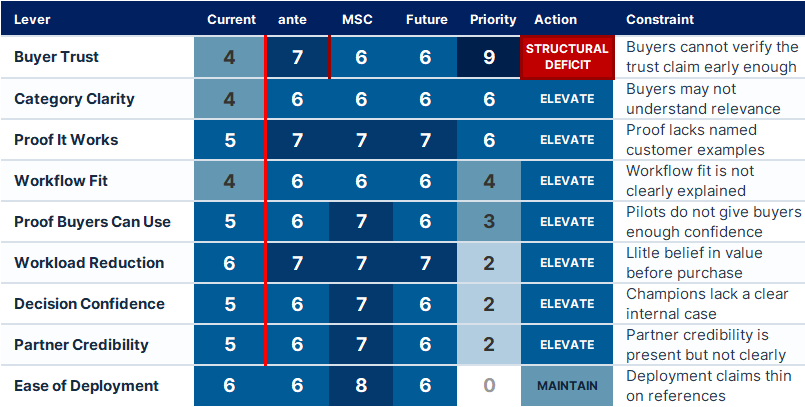
This company shows a different pattern: the Proof Timing Gap.
The buyer must approve deployment risk, adoption risk, internal scrutiny, and ownership risk before the product is live.
The buyer has to believe the product will work, understand what implementation requires, and defend the decision internally before proof is fully visible.
The friction is clear:
Buyers need deployment clarity before procurement
Champions need proof they can use inside the organization
Technical value needs to become business-risk language
Security, finance, legal, and operations all need a reason to support the decision
A strong product can still be a hard decision to defend.
The shift is to make proof visible before the buyer enters a buying motion.
Standard proof tools do not carry enough of the buyer’s burden.
A demo shows what the product does.
A POC shows how it performs in a limited setting.
Both can still leave the buyer with a heavy lift:
turning technical evidence into business confidence
explaining deployment risk
building support across security, finance, legal, operations, and procurement
For this company, bringing the existing value forward means:
a pre-purchase proof pack that shows the threat, current exposure, protection path, and cost of waiting
a deployment confidence map that shows steps, owners, approvals, timing, integrations, and risk controls
buyer-language proof tied to fewer exposures, lower response burden, cleaner audit posture, and lower operating risk
a champion-ready case that explains the problem, the current gap, what changes after deployment, and why the move is safe to support
demos and POCs used as confirmation tools, not the main proof engine
The goal is simple:
Reduce the work the buyer must do to defend the decision.
Why the table matters
The Course Correction Canvas shows which levers matter.
The RSEI table shows where effort belongs.
For the MSSP, the required work is Innovate: create the missing evaluation-entry structure.
For the red teaming portal, the required work is Elevate: bring proof forward in a form the buyer can use before commitment.
The table keeps those moves separate.
A missing structure should not be treated like a weak tactic.
A proof problem should not be handed back to the buyer through a demo or POC.
A strength should not consume resources that belong on a higher-friction lever.
That is the point of the RSEI.
It turns movement into work:
Name the lever
Read the signal
Understand the constraint
Choose the move
Remove. Shrink. Elevate. Innovate. Maintain or defer.
The goal is simple:
Turn scattered activity into directed movement.