


You can be technically superior and still be commercially inferior.
It may even be the strongest thing in the stack.
Customers may only feel the real value once it is live.
By then, the buying decision is already behind them.
That is what this Market Friction and Activation Map is built to show.
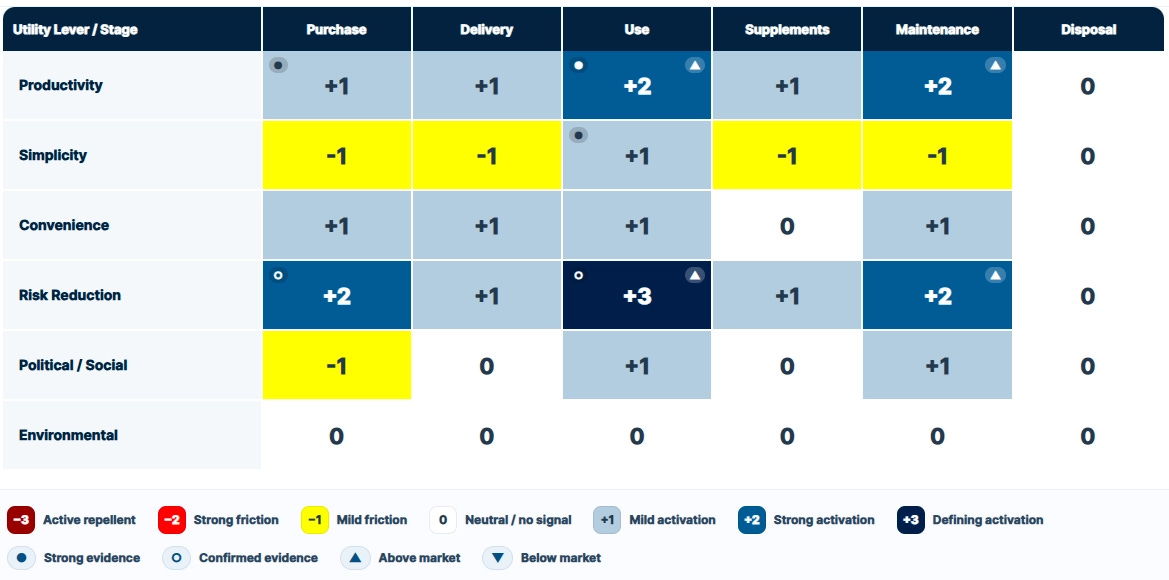
It shows where value lands in the buyer journey.
It shows where friction in the buying journey shows up.
It also shows how strong the signal is and whether the company is ahead of, behind, or in line with the market at that point in the journey.
That matters because not all friction means the same thing.
A weak score with weak evidence is one kind of problem.
A weak score with strong evidence is another.
A strong value area where the company leads the market tells a very different story from one where the company is only average.
The point is to see what the journey is really doing to the buyer.
The strongest value shows up once the product is live.
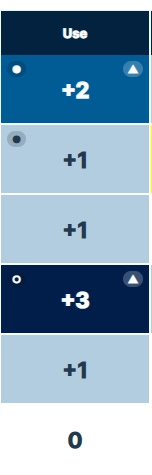
That is where the market sees the biggest gains in risk reduction and productivity.
That is especially true during Use and Maintenance.
In several of those cells, the evidence supports above-market performance.
Core product value is not the problem.
The problem shows up earlier.
The weak spot is simplicity before and around activation.

It means the path into value feels heavier than it should.
The buyer has to put in real effort before they can feel the product’s worth.
Good companies get stuck assuming the answer is to explain the product better, add more proof, or push harder in the sales cycle.
When value lands in Use, but friction shows up in Purchase, the job is to help the buyer experience more of the value before they are asked to carry the full cost of change.
Decision makers need compelling reasons to believe two things:
The decision is safe to champion.
The value of movement outweighs the cost of consequence.
Bringing confidence forward matters.
If the strongest value shows up later, then part of that value has to be brought forward earlier in the journey.
That can take different forms.
Bring onboarding forward into the sales cycle before commitment.
A dedicated technical guide who walks them through the full journey.
Pre-validated playbooks that make the likely outcome easier to see before the customer has to imagine it on faith.
Reduce the amount of uncertainty, effort, and coordination the customer has to absorb before the value becomes real.
Buyers expect this part to be hard.
Change that, and you change the journey.
Keep the depth.
Make the course easier to navigate.
That is the difference between a product that creates value and a journey that lets customers reach it.
And that difference matters more than most pipeline reports can see.