


An Open Water snapshot
Today’s subject (aka “Pay!”) is a SaaS platform that helps finance teams verify supplier and payment details before money moves. It operates near some of the most sensitive workflows inside finance: supplier onboarding, accounts payable, fraud prevention, payment approval, and payment release.
That gives “Pay!” a strong problem to solve.
Finance teams are under pressure to stop payment fraud without slowing the business down. They need more confidence before money leaves the organization. They need fewer manual checks. They need better visibility across fragmented finance systems. They need to know when a payment is safe to release.
But the strategic challenge for “Pay!” is larger than fraud prevention.
The company appears to have momentum in a market with real need. The question is whether that momentum can become a durable market position.
Can “Pay!” scale while protecting a distinct moat as ERP, treasury, accounts payable, banking, and payment-execution platforms move closer to the same trust decision?
The question for “Pay!” was whether the company had fully defined the value it creates.
Vendor verification is an important capability, but capabilities are rarely what customers ultimately buy. The framework challenged the assumption that verification was the primary source of value and tested whether customers were pursuing broader outcomes: greater payment certainty, lower operational friction, and faster financial operations.
If those are the outcomes customers value most, then the market surrounding “Pay!” may be considerably larger than the category the company currently occupies.
Following the strategic trail
The goal of this article is not to walk through every step of the Open Water Framework. A full Strategic Navigation Assessment explores far more evidence than we could reasonably cover here.
Instead, we’ll follow the key moments that changed the strategic direction.
Each asset asks a different question about the business, the market, the competition and the customer. As those questions are answered, assumptions are challenged, the strategic frame begins to shift, and a different view of the market emerges.
For this walkthrough, we’ll focus on the assets that produced the largest changes:
Sea State
Buyer Journey Value Map
Course Correction Canvas
Strategy Canvas
Strategic Reframing
Adjacent Growth Targets
Expansion Fit Signals
Strategic Recommendations
Rather than explaining every detail of the framework, we’ll focus on what each visual revealed, how it changed our thinking, and why those insights led to a different strategic conclusion.
1. Sea State
The Sea State is where the assessment begins.
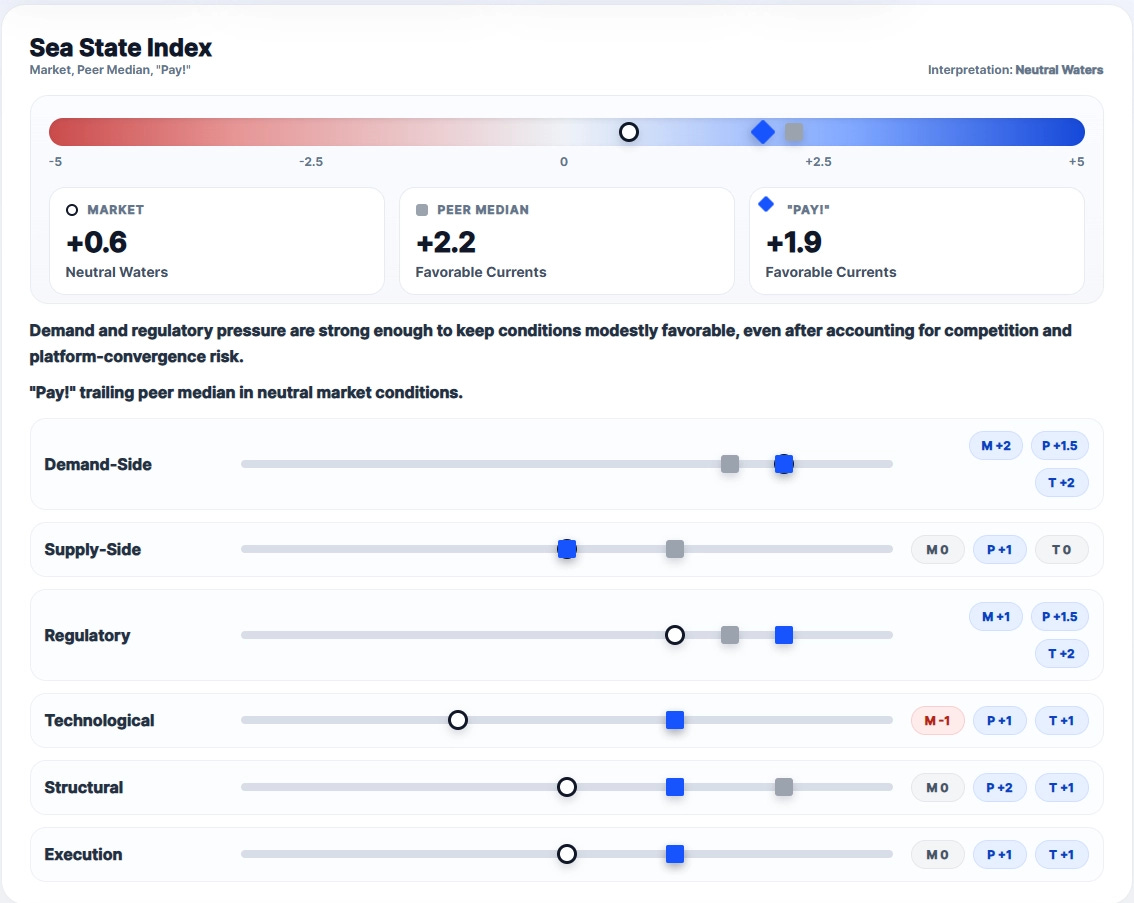
Its job is to show the environment surrounding the company. It looks at the market, the peer median, and the target company (”Pay!”) to understand whether the conditions are helping, resisting, or exposing a gap.
This matters because companies often misread momentum.
A market can be growing and still become harder to defend. Demand can rise while the competitive position weakens. A company can be solving a real problem while larger platforms move closer to absorbing the same function.
[Sea State Index and sub-forces]
For “Pay!”, the Sea State showed a favorable but contested environment.
There is real demand. Payment fraud, supplier risk, payment approval, and finance-control pressure are not abstract issues. Finance teams have a growing reason to care.
But the Sea State also showed something more important.
“Pay!” is not operating in empty water.
The peer median sits stronger. ERP, treasury, accounts payable, banking, and payment-execution platforms are all relevant because they sit close to the workflow where payment trust is formed.
That creates the first major test:
💡Is “Pay!” competing in vendor verification, or is the market reorganizing around payment-release trust?
The Sea State did not answer that fully, but highlighted where to go next
2. Buyer Journey Value Map
The Buyer Journey Value Map looks at three questions simultaneously.
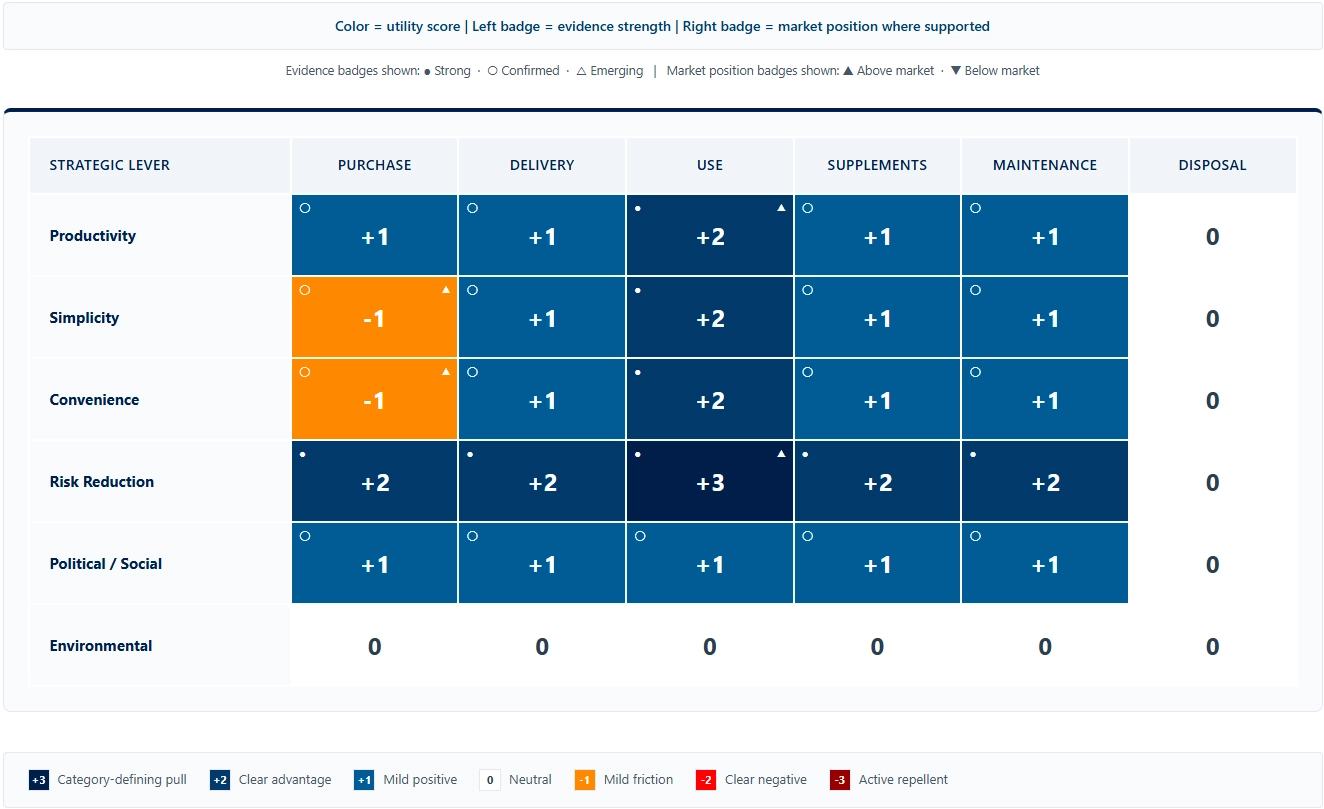
First, where does the buyer experience value? Second, how strong is the evidence supporting that conclusion? Third, how does the company compare to normal market expectations at each stage of the buyer journey?
Viewed together, the picture becomes much more useful than looking at utility scores alone.
[Buyer Journey Map +BEEP (Buyer Evidence Extraction Protocol)+MPS (Market Position Score)]
The utility layer shows what most people would expect. Risk reduction is the dominant source of value, and that value becomes even stronger once the platform is in use.
The more interesting story comes from the evidence layer.
At nearly every stage of the journey, the Buyer Evidence Extraction Protocol demonstrates that these outcomes are supported by strong, defensible evidence rather than marketing claims. Risk reduction is consistently supported by the strongest available evidence, while the remaining strategic levers are broadly confirmed across the buyer journey.
The Market Position Score adds another layer of context.
Where sufficient market evidence exists, “Pay!” performs at or above normal market expectations. Productivity during use exceeds the market average. Risk reduction during use stands above the market. Even during the purchase stage, when buyer friction is highest, “Pay!” performs at or above the level buyers typically experience elsewhere.
Taken together, these three layers fundamentally change the interpretation of the problem.
The company has credible proof, meaningful differentiation, and outcomes that compare well against the broader market. The constraint on growth does not appear to be the product itself or the value it delivers.
If the product is demonstrably creating value, and the market evidence supports those claims, the next question becomes:
If the value is real and the proof exists, what is limiting growth?
That question serves as the bridge to the next stage of the framework.
3. Course Correction Canvas
The Buyer Journey Map demonstrated that “Pay!” creates meaningful value throughout the customer relationship. The evidence is strong, the outcomes compare favorably against the market, and the product consistently delivers on its promise.
If customers recognize that value after deciding a solution is worth pursuing, what determines whether they decide the problem deserves attention in the first place?
The Course Correction Canvas shifts the investigation from how customers experience a solution to how customers decide a problem is important enough to solve. It examines the hierarchy of priorities customers use before a buying journey begins, while also revealing where your company sits within that decision process and where it must move to become the preferred solution.
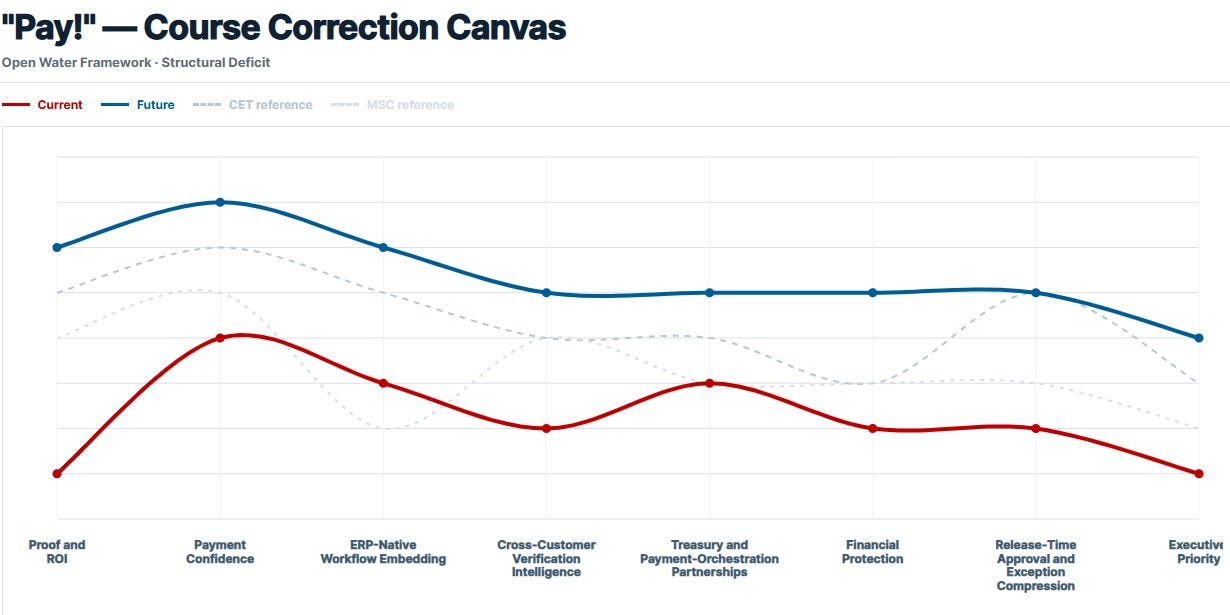
[Course Correction Canvas showing Current Position, Future Position, Customer Expectation Threshold (CET), and Market Structural Constraint (MSC) The decision levers are arranged from highest to lowest influence on the customer’s prioritization process]
Each lever represents a decision criterion customers increasingly use when deciding whether this problem deserves investment.
Beginning with Proof & ROI, the hierarchy continues through Payment Confidence, Workflow Integration, Shared Intelligence, Payment Ecosystem, Financial Protection, Approval Confidence, and Executive Priority. Together, these levers describe the expectations customers increasingly place on companies they trust to solve important business problems.
“Pay!” creates meaningful value once customers engage. The Buyer Journey has already demonstrated that those outcomes are real, well-supported, and compare favorably with the broader market.
However, across many of the highest-priority decision criteria, “Pay!” remains below the Customer Expectation Threshold. More importantly, even substantial improvement over a realistic planning horizon leaves the company approaching, but still short of, those expectations. The Market Structural Constraint defines the practical limit of what execution alone can achieve within the current market.
That gap is a significant signal called a structural deficit.
The constraint lies in the market’s ability to recognize and reward emerging capabilities quickly enough for them to become organizational priorities.
The market is organized to validate these capabilities more slowly than customer expectations continue to evolve.
“Pay!” enters the customer’s decision process only after the organization has already decided that an external solution is warranted. Under “Pay!”’s current value framing, it is evaluated as a solution rather than prioritized as a business outcome.
How do you become the reason the organization chooses to solve the problem in the first place?
4. Strategy Canvas
The Course Correction Canvas established that “Pay!” enters the customer’s decision process too late and through a value frame that limits strategic priority.
Once customers decide the problem is worth solving, what influences which solution they ultimately choose?
The Strategy Canvas answers that question through a competitive lens.
If customers evaluated companies across these eight dimensions, what story would “Pay!” tell?
Rather than comparing products, features, or technical capabilities, the Strategy Canvas compares the dimensions of value customers use to distinguish one solution from another. The objective is to understand where the company creates value, where that value is diluted by the market, and which dimensions offer the strongest opportunities for strategic ownership
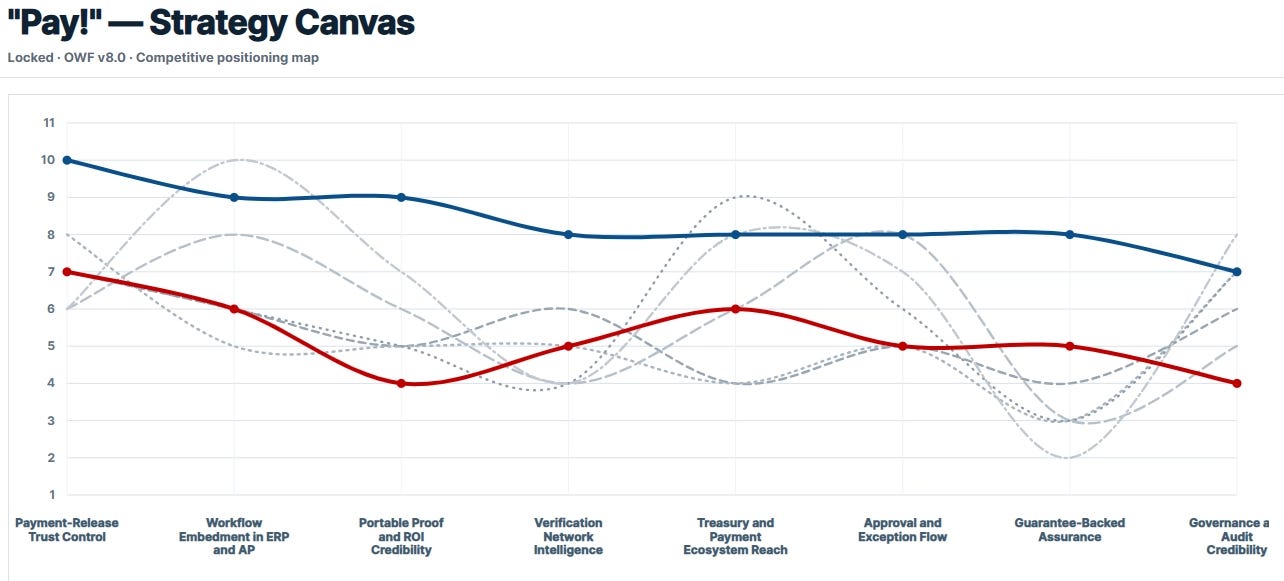
[Strategy Canvas comparing “Pay!” against the broader market across the primary value dimensions customers use to distinguish competing approaches.]
“Pay!” consistently remains within reach of the leading group across many of the highest-value dimensions. The company possesses sufficient capability to compete effectively, yet its profile does not clearly establish ownership of a single value spine that customers instinctively associate with its brand.
Portable Proof & ROI represents an opportunity to strengthen market confidence. Guarantee-Backed Assurance provides another opportunity to create meaningful separation. Across the remaining dimensions, “Pay!” remains competitive without establishing a distinctive pattern that customers immediately recognize.
The Strategy Canvas reinforces what the Course Correction Canvas revealed.
Product and execution issues take a backseat to creating a value profile that customers can immediately recognize and prioritize.
Instead of asking, “How do we compete?” the question becomes:
Which value spine is worth owning, and which customers are most likely to recognize it first?
5. Strategic Reframe
The investigation is complete. The evidence now points toward a strategic reframe.
The Buyer Journey Value Map demonstrated that “Pay!” creates meaningful value once customers engage. The Course Correction Canvas showed that the company enters the customer’s decision process too late to influence whether the problem becomes a priority. The Strategy Canvas confirmed that “Pay!” possesses the capability to compete, but it does not yet own a distinctive value spine that customers immediately recognize.
Taken together, the conclusion is clear.
The opportunity is not to improve the product. It is to improve how the market understands the product, who recognizes its value first, and how the commercial organization identifies and engages those customers.
The prescription unfolds in four steps.
First, the message must be reframed around the business outcome customers are trying to achieve. Second, the growth targets must shift toward the organizations inside the existing ICP where that outcome carries the greatest weight. Third, the company needs a new set of fit signals to identify which of those organizations are most likely to respond to the reframed message and which commercial playbook to use. Finally, those insights must become an executable strategy for the leadership team.
Reframe the Message
Every strategic shift begins by changing the conversation.
The investigation showed that “Pay!” is currently understood as vendor verification software. While accurate, that description places the company inside an established category where buyers naturally compare products, features, and incumbent vendors.
The stronger frame shifts attention from product capability to business outcome.
Rather than leading with vendor verification, “Pay!” begins with confidence before money moves. The conversation changes from validating vendors to helping organizations release payments with greater confidence, lower operational friction, and stronger financial control
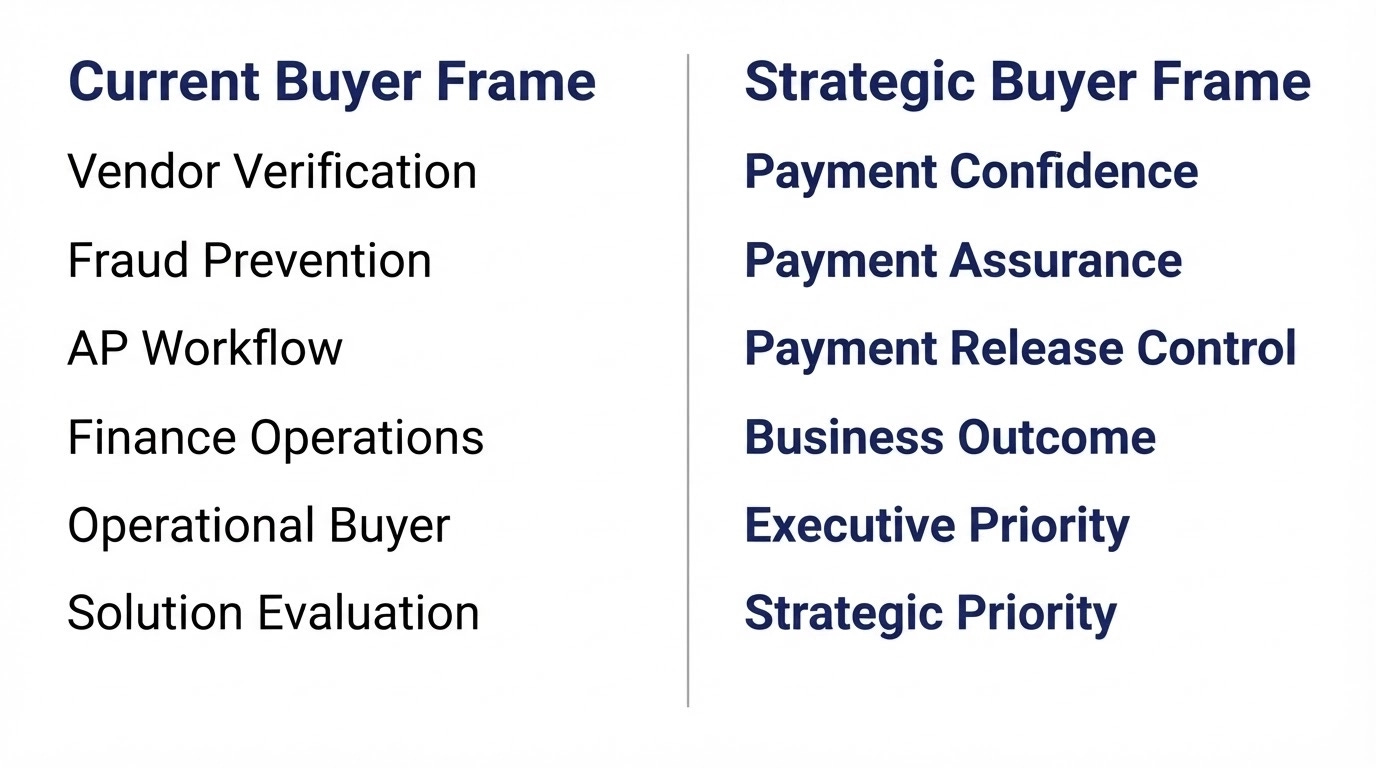
[Sample buyer reframing for “Pay!”]
This matters because the current frame places “Pay!” into an established buying process alongside incumbent vendors. The new frame positions the company around a broader business outcome, where buyer priorities are still forming and the competitive landscape is less defined.
Changing the message changes something even more important.
It changes who is most likely to recognize the value.
Reframe the Growth Targets
A stronger message does not require a new market. It requires finding the organizations inside the existing ICP that naturally place greater value on the reframed outcome.
The investigation suggests that the greatest opportunities are not found by expanding into unfamiliar markets. They are found by moving toward the underserved edges of the existing market, where confidence before money moves solves a more immediate business problem.
For “Pay!”, those organizations share common characteristics. Payment confidence is fragmented across systems. Approval authority spans multiple teams. Finance operations cross legal entities or geographic boundaries. Urgent payment scenarios create operational pressure. Governance expectations continue to rise.
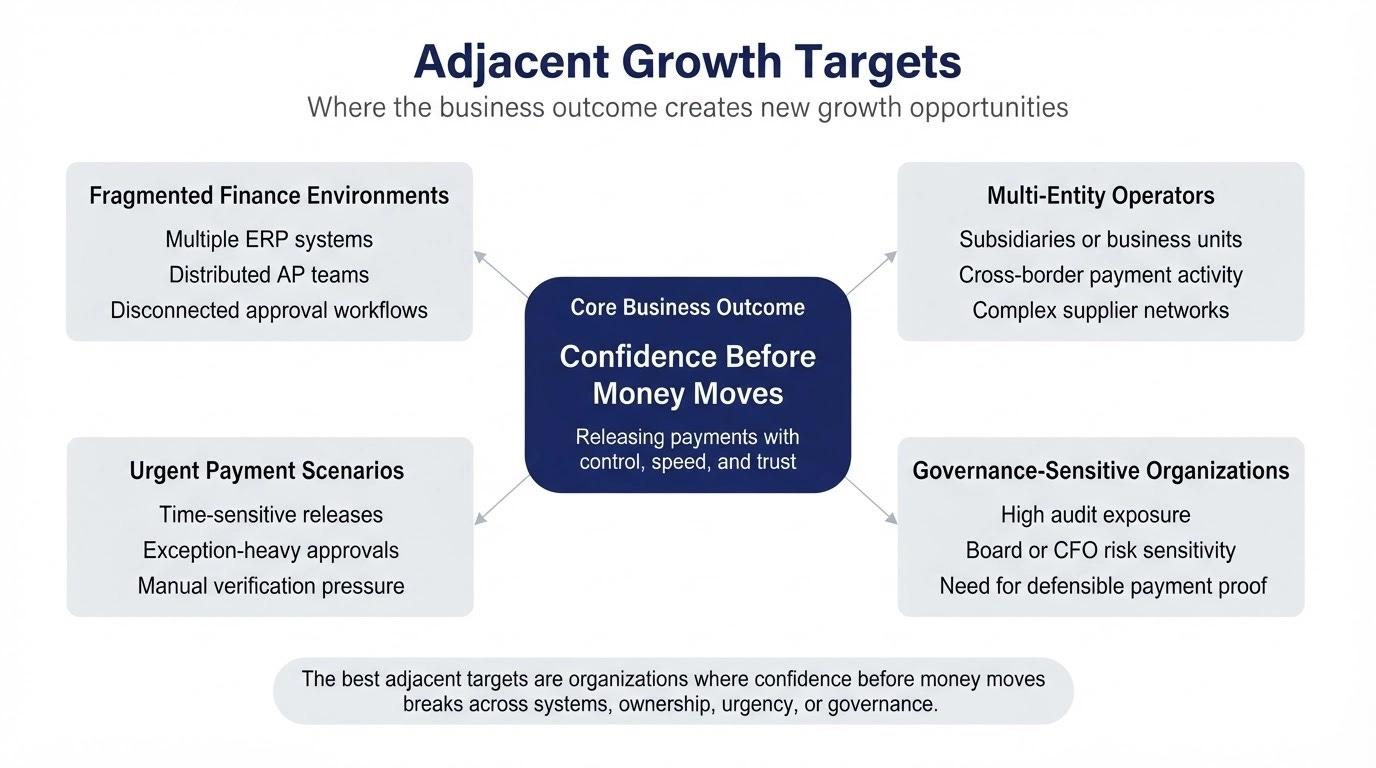
[Identified adjacent growth targets for “Pay!”]
These organizations may never describe their challenge as vendor verification. They are far more likely to describe it as difficulty maintaining confidence throughout the payment release process.
The message has changed.
The target changes with it.
Reframe the Customer
Finding adjacent growth targets answers the question of where the opportunity exists.
Expansion Fit Signals answers which organizations are most likely to respond.
This exercise assesses the customer’s readiness for the reframed conversation rather than simply determining whether the organization belongs within the ICP.
The strongest opportunities share recognizable signals. Payment approvals require multiple stakeholders. Trust breaks across systems. Executive attention toward financial governance is increasing. Existing finance platforms still require manual checks of confidence before funds are released. Operational friction continues despite investments in automation.
Those signals confirm more than product fit.
They confirm that the organization is likely to value the reframed business outcome and provide guidance on the commercial playbook most likely to resonate with that customer.
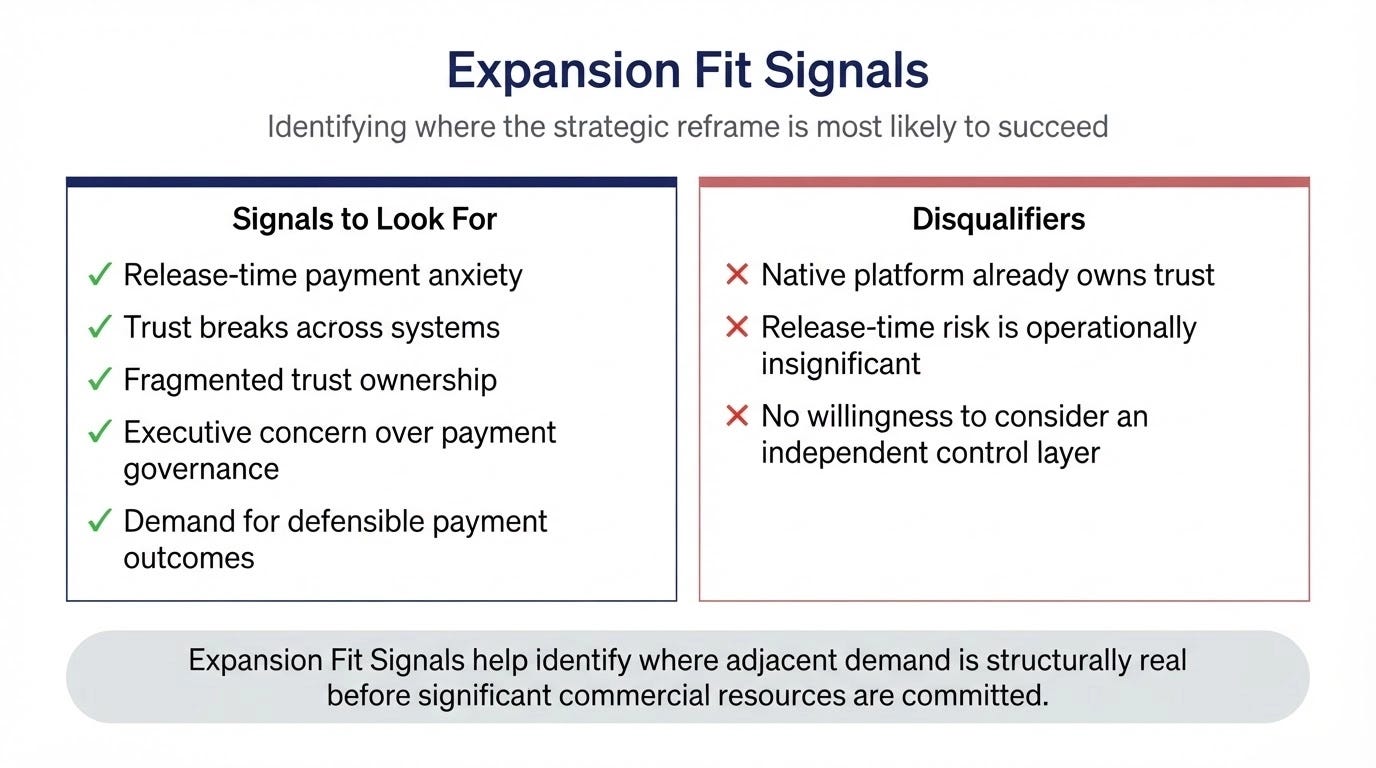
[Sample of expansion fit signals for “Pay!”]
Different operating environments require different conversations, different proof, different executive stakeholders, and different activation strategies. The objective is no longer to pursue every organization inside the ICP equally. The objective is to identify the organizations most likely to recognize the new value frame before the conversation becomes a traditional product comparison.
Execute the Shift
The investigation now translates into action.
Vendor verification remains an important capability, but it should no longer define the company’s market position.
Leadership should stop leading with the smallest category the company can occupy and begin leading with the business outcome customers increasingly want to achieve.
The commercial organization should shift its center of gravity toward confidence before money moves, supported by stronger executive messaging, deeper workflow integration, portable proof, and customer evidence that reinforces the new value spine.
The result is a commercial strategy that aligns the message, the market, the customer, and the playbook around the same business outcome.
What Changed
The Open Water investigation began with a company seeking stronger growth.
“Pay!” creates meaningful value. Customers recognize the value once they engage, and market evidence confirms that the product delivers on its promise. The investigation showed that the greatest opportunity lies in influencing the decision before the buying journey begins.
The strategic reframe reshaped the commercial approach. The message shifted toward confidence before money moves. The growth targets shifted toward the organizations inside the existing ICP that highly value that outcome. Expansion Fit Signals identified where adjacent demand is structurally real, allowing the commercial team to focus its effort where the new value proposition is most likely to succeed.
The result is a strategy that aligns the message, the market, the customer, and the commercial approach around a single business outcome.
That is the purpose of the Open Water Framework.
To reveal opportunities that conventional market analysis often overlooks and translate them into an executable strategy for growth.