


If you are not seen, you cannot compete.
If you are not believed, trusted, and proven, you cannot win.
Post #11 - Strategy Canvas looked at that condition.
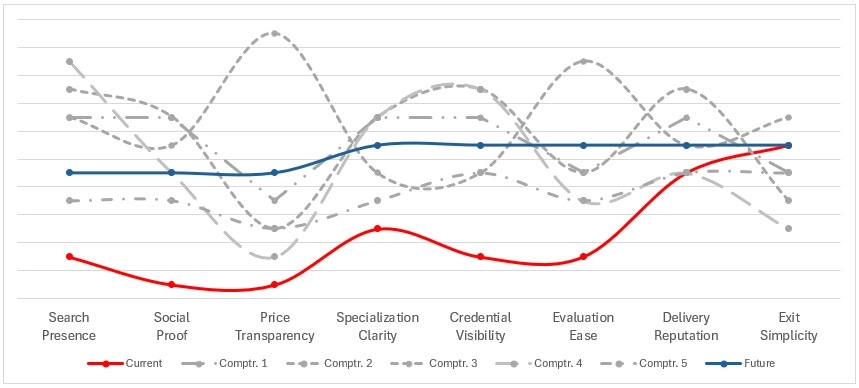
A company sits below the market on every visible lever:
search presence
social proof
pricing clarity
specialization
credentials
ease of evaluation
That is a structural issue. One the company must address.
But structural fixes take time.
And deals are happening now.
So what do you do for the deals you are already in?
The buying action is already moving.
Other providers were invited. You fought your way in.
That requires a strategy shift.
Move from “how do we compete?” to changing the levers and the framing the buyer uses to make the decision.
The real move: Change the question the buyer is trying to answer
Every buyer enters a process with a working scorecard.
It may not be written down.
But it is active.
They are asking:
Can I find you?
Do others trust you?
Can I compare you easily?
Do you look like the kind of provider I expected to evaluate?
When your visibility is weak across those dimensions, the comparison will not favor you.
Do not argue harder inside that frame.
Help the buyer see a condition they have not weighted heavily enough.
A condition that may decide whether the outcome works.
How the shift happens
The conversation follows a clear pattern:
Confirm what the buyer already values: “Yes, these factors matter.”
Introduce an additional/missing condition(s) Factors that directly affect success, but are not fully considered yet
Elevate that condition to decision importance: “If this is not handled correctly, you won’t see the desired outcome.”
Anchor the evaluation around it, not as an add-on, but as a central requirement
Change the ruler for success and the lens for risk.
This is a live-deal motion
It operates with specific characteristics:
high effort
non-scalable
deal-by-deal
requires access to the buyer
requires strong sales skills
It depends on a real understanding of the buyer’s situation.
And the ability to guide the conversation with precision.
What you are really doing
You are helping the buyer see something that will shape the outcome.
Competitive evaluations give the most weight to the levers easiest to compare:
visible proof
known credentials
structured evaluation
past outcomes
Those factors matter.
Your opening is in how they are framed, where they affect the outcome, and what the buyer has not yet weighted correctly.
The lever you are looking for
The lever has to meet three tests:
It directly influences whether the engagement succeeds
It is underweighted in the current evaluation
You can own it with clarity and confidence
When those tests are met, the conversation has somewhere new to go.
Use this only when you can deliver
This approach is a bridge, not the long-term engine.
The long-term work is still to build visibility and proof across the levers the market already trusts.
That is what creates scale.
In the deals already moving, you need something different.
You need to identify the condition that determines whether the decision actually works, bring it forward, and build the conversation around it.
That only works when the condition is real.
Use this when you can create a measurable outcome for the customer.
If the lever is artificial, winning becomes the risk.
You get a customer whose needs you reframed, but cannot fully satisfy.
That damages trust, weakens reputation, and pulls the company away from places where it can create real value.
The goal is to help the buyer see the condition that will make the outcome succeed.