


Buyers do not come to you with a blank slate
Before the buying motion starts, they have already formed a view of:
What challenge are they trying to solve?
Which levers matter most?
How might they solve it?
Who can help them reach the outcome?
That is why visibility on the right levers matters.
Earning your right to compete
Before buyers start a purchase motion, they scan the market for signals that justify inclusion:
proof they can understand
a category they can place
outcomes they can explain
examples they can trust
a reason to pay attention
If those signals are weak, unclear, or hard to find, you do not earn a seat during the next motion.
Your value may be real.
Your proof may be strong.
Your delivery may be excellent.
But buyers only include what they can see, understand, and compare.
Where the market decides
A Strategy Canvas shows the top eight levers the market uses to make a buying decision.
It compares how you rank on those levers against your closest competitors.
It shows clearly where you are:
providing a clear advantage
easy to include
hard to understand
filtered out entirely
It also shows where you could move if your strategy, message, proof, and go-to-market motion tighten around the right levers.
The point is simple:
Find the levers you can own.
Build around them.
Stop wasting energy on areas where competitors already control the buyer’s mind.
Invisible to the market
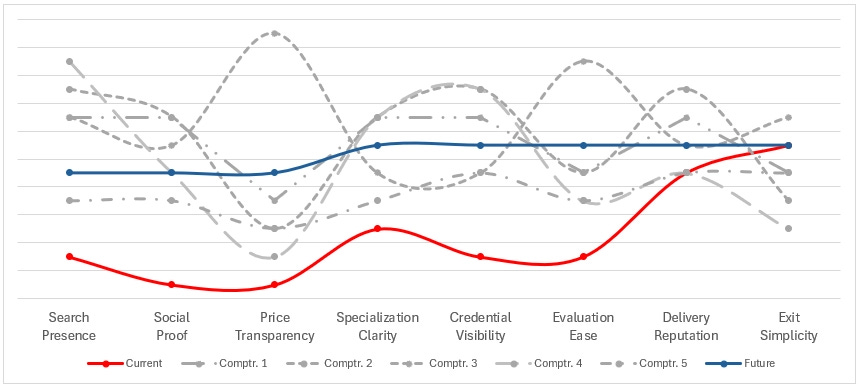
This company sits behind the market on almost every lever that decides inclusion.
They are hard to find.
Their proof is hard to see.
Their pricing creates confusion.
Their advantage is unclear.
Their credentials are hard to verify.
Buyers have no clean way to evaluate them against alternatives.
In other words, they are invisible where the market is already making decisions.
Building the proof layer that earns inclusion
This company needs to reach market parity.
That starts with the minimum market-visible proof layer buyers expect.
Build five assets:
Search proof: A page that answers the exact problem buyers search for, using the language they already use.
Credential proof: A visible trust layer with customer names, partner signals, certifications, leadership credibility, or documented experience.
Outcome proof: Three short examples that show the before state, the work performed, and the measurable change.
Pricing clarity: A simple explanation of how pricing works, what drives cost, and what a buyer should expect.
Comparison clarity: A plain-language guide showing when to choose you, when to choose an alternative, and what makes the difference.
Building proof is only half the move.
The market has to ****encounter it before the buying motion starts.
That requires distribution:
Place proof where buyers already look.
Repeat the same signals across every entry point.
Make proof easy to find in seconds.
Answer “why consider you” at first touch.
Reinforce the same examples until they become recognizable patterns.
Proof that sits still does not change market judgment.
Proof that shows up early, often, clearly, and consistently earns inclusion.
That is when conversations begin.
The strategic shift
Design the first proof layer as carefully as the product.
That proof layer should answer:
What problem do we solve?
Where have we solved it?
What changed?
Who should care?
Why now?
Give buyers every reason to include you before the first conversation.